
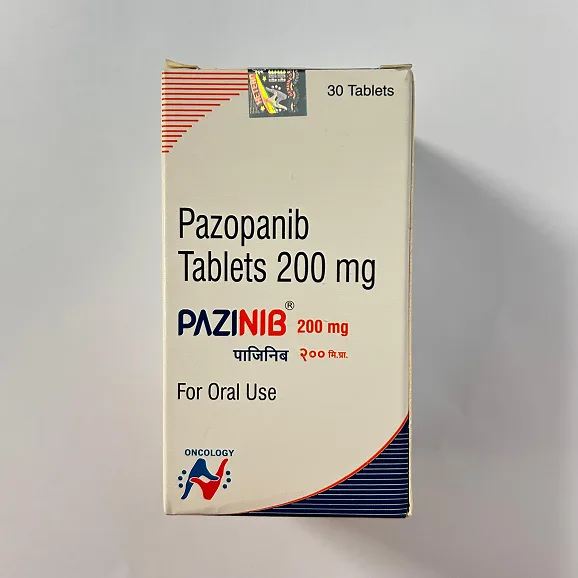
Pazopanib Tablets Pazinib
| Product/Composition | Pazopanib Tablets |
|---|---|
| Strength | 200mg |
| Form | Tablets |
| Production Capacity | 10 Million Tablets/Month |
| Packaging | 10 X 10 Tablets / Box |
| Therapeutic use | Renal Cell Carcinoma & Soft-Tissue Sarcoma |
| Package Insert/Leaflet | Available upon request |
| Brand Name | Pazinib |
Pazopanib Tablets – Pazinib contain Pazopanib, an oral targeted anticancer medicine belonging to the tyrosine kinase inhibitor (TKI) class. It is used for the treatment of advanced renal cell carcinoma (RCC) and certain advanced soft-tissue sarcomas in appropriate clinical settings.
Pazopanib works by inhibiting several receptor tyrosine kinases involved in tumor growth and angiogenesis, including vascular endothelial growth factor receptors (VEGFR), platelet-derived growth factor receptors (PDGFR), and KIT. By inhibiting these signaling pathways, Pazopanib can interfere with tumor-cell growth and the development of blood vessels that support tumors.
Pazinib is a prescription medicine that should be used under the supervision of an oncologist. Treatment requires appropriate monitoring because Pazopanib can affect liver function, blood pressure, cardiac function, and other systems.
What is Pazopanib?
Pazopanib is a multi-targeted tyrosine kinase inhibitor (TKI) and targeted antineoplastic medicine. It inhibits signaling pathways associated with angiogenesis and tumor-cell proliferation.
It is primarily used in selected patients with advanced renal cell carcinoma and advanced soft-tissue sarcoma.
Benefits / Uses
Pazopanib Tablets may be used for:
- Advanced renal cell carcinoma (RCC)
- Advanced soft-tissue sarcoma in selected patients
- Other indications only where supported by applicable regulatory approvals and oncology protocols
The specific indication and treatment plan should be determined by the treating oncologist.
Dosage Guidelines
Pazopanib is administered orally according to the prescribed treatment regimen.
- Pazopanib is generally taken once daily.
- Tablets should be swallowed whole with water and should not be crushed or split unless specifically instructed.
- It should generally be taken without food, at least 1 hour before or 2 hours after a meal.
- Blood pressure should be monitored during treatment.
- Liver-function tests should be performed regularly, particularly during the early stages of treatment.
- Dose interruption or reduction may be required in response to adverse effects or liver-function abnormalities.
- Patients should inform their healthcare professional about all medicines they are taking because Pazopanib has clinically important drug interactions.
The exact dose and duration should always follow the approved product information and oncologist’s instructions.
Wholesale & Supply
Pazinib – Pazopanib Tablets can be supplied for hospitals, oncology centers, pharmaceutical distributors, wholesalers, and international healthcare markets, subject to applicable regulatory requirements.
Bulk pharmaceutical buyers can request:
- Available strengths and presentations
- Packaging configuration
- Minimum order quantity
- Production and supply capacity
- Certificate of Analysis (CoA)
- Product documentation
- Regulatory and export documents
Buying Online
Pazopanib is a prescription anticancer medicine and should only be procured through authorized pharmaceutical suppliers and used under qualified medical supervision.
Hospitals, licensed distributors, and healthcare procurement organizations can contact the supplier for product availability, commercial quotations, and applicable documentation.
Reviews
Individual responses to Pazopanib treatment vary according to cancer type, disease characteristics, treatment history, dosage, and patient factors. Treatment decisions should therefore be based on professional oncology assessment rather than individual product reviews.
Quality Assurance
Pazinib should be manufactured and handled according to applicable pharmaceutical quality requirements. Quality-control procedures for tablets may include:
- Identity and assay
- Purity and related substances
- Uniformity of dosage units
- Dissolution
- Stability testing
- Packaging and container-closure integrity
Product-specific quality and regulatory documentation can be provided upon request, where applicable.
Frequently Asked Questions
What is Pazinib used for?
Pazinib contains Pazopanib and may be used for advanced renal cell carcinoma and selected advanced soft-tissue sarcoma treatment protocols.
What type of medicine is Pazopanib?
Pazopanib is a multi-targeted tyrosine kinase inhibitor that inhibits signaling pathways involved in tumor growth and angiogenesis.
How is Pazinib administered?
Pazinib is administered orally as tablets, generally once daily according to the prescribed treatment regimen.
Should Pazopanib be taken with food?
Pazopanib is generally taken without food, at least 1 hour before or 2 hours after eating, according to prescribing instructions.
What are the important side effects of Pazopanib?
Potential adverse effects include hypertension, diarrhea, nausea, fatigue, hair-color changes, loss of appetite, and liver-function abnormalities. More serious cardiovascular, bleeding, gastrointestinal, and other complications can also occur.
Does Pazinib require specialist supervision?
Yes. Pazopanib is a targeted anticancer medicine that requires monitoring of blood pressure, liver function, and other relevant clinical parameters under oncology supervision.
Conclusion
Pazinib – Pazopanib Tablets is an oral targeted anticancer medicine belonging to the tyrosine kinase inhibitor class. It is used primarily for advanced renal cell carcinoma and selected advanced soft-tissue sarcomas. Appropriate monitoring of liver function, blood pressure, and potential drug interactions is important during treatment.